Meetings go silent in your head? ‘Be confident’ misses one score first
335 of 1,851 nervous speakers picked not sounding confident as their biggest challenge. But the number to check comes from a different moment.
 By Maria Lee·

You know the meeting moment. Someone says, “What do you think?” and the answer you had in your head disappears. The faces on the video call turn toward you. Your mouth opens before your sentence is ready. If the advice you hear is just be confident, it can feel like being told to be taller.
In AmberWillo onboarding answers from 1,851 people working on their speaking nerves, 335 people picked not sounding confident as their single biggest challenge. That is 18% of the group. But confidence was not the largest problem people named. And the number that makes confidence advice more useful does not come from asking people what they want to feel. It comes from a different moment. We will get to that near the end.
- Mind goes blank or forget what to say38%
- Speak too fast when nervous21%
- Don't sound confident18%
- Use too many filler words11%
- Sound monotone or flat9%
- Don't know what to do with hands or face3%
Share of 1,851 AmberWillo onboarding answers from people working on speaking nerves, Dec. 2025 to Oct. 2026. Respondents picked one biggest challenge.
Confidence advice sounds right because the blank feels personal
The blank is easy to mistake for a confidence problem. It arrives in public. It happens while people are watching. It makes you feel exposed, even if the room is friendly. So the conclusion seems obvious: if you were more confident, the words would come out.
But that skips a step. The largest group in the onboarding answers did not say their main problem was sounding unconfident. They said their mind goes blank, or they forget what they wanted to say. That answer came from 38% of the group. Speaking too fast came next at 21%, then not sounding confident at 18%.
That order matters because the phrase be confident is broad. It can cover voice, posture, pacing, eye contact, word choice and nerves all at once. When a meeting goes quiet and everyone waits, broad advice gives you too many things to fix at the same time. It names the feeling you want, but not the moment where you can measure whether anything is changing.
Meetings make the advice even less specific
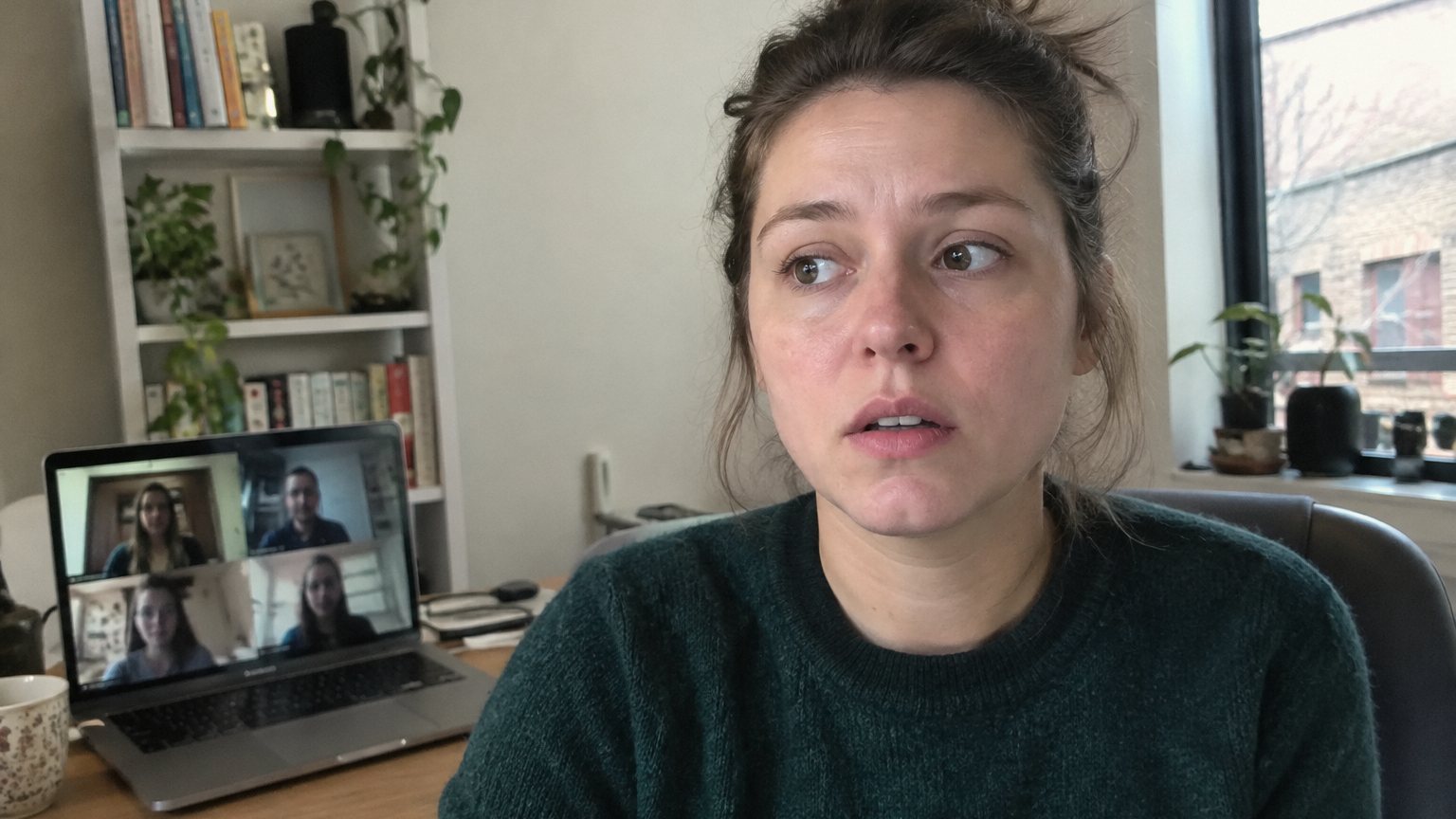
A meeting is not a stage, but it can feel like one for a few seconds. You may be listening quietly, then suddenly become the person everyone is waiting on. The pressure is not only the topic. It is the switch. One second you are following along. The next second you are expected to produce a clear answer.
That is where be confident breaks down as advice. It names a desired feeling, but it does not name a behavior you can repeat. It does not tell you how to start a sentence after your name is called. It does not tell you what to do with the two seconds when your thoughts scatter.
It can also make practice feel strangely all-or-nothing. If the goal is to feel confident, then a shaky round feels like a failed round. If the goal is to notice a concrete score after speaking, the same round becomes information. That difference is why the missing number matters. It does not prove why anyone freezes. It does not promise a fix. It simply gives a more concrete way to look at confidence than asking, “Do I feel ready yet?”
So the useful question is not whether you already feel like a confident person before the meeting starts. It is what happens when the pressure is present, the camera is on and you have to speak anyway. That is the different moment we have been pointing toward.
The first score confidence advice misses
Among 885 nervous speakers who completed at least one AmberWillo practice session, the median confidence score after the first completed practice round was 6.4 on a ten-point scale.
That is the finding confidence advice often leaves out. Many people do not start at zero. They also do not start feeling fully steady. They start in the middle. If your mind blanks in meetings, that middle can be frustrating because it does not feel like failure, but it also does not feel reliable when attention turns to you.
A middle starting point is easy to misread. You may assume you should wait until you feel calm enough to speak, or until you can guarantee that your answer will sound polished. The data does not say that confidence causes better speaking, and it does not say one round is enough. It only shows that the first measurable confidence score for people who practiced was not blank, and it was not perfect.
What this means for you
If your mind goes blank when people look at you, do not make confidence the only goal. Treat confidence as one signal from a speaking round, not as the thing you must somehow generate before you speak.
Practice the switch, not just the content. Start from silence, then speak for 30 seconds. That trains the moment when attention lands on you.
Use a first score as a baseline. A middle score is not a verdict. It tells you where the next round starts.
Prepare one opening sentence. In a meeting, the first words matter because they get you moving. Try: “My first reaction is…” or “The main tradeoff I see is…”
Do not wait to feel confident first. Run a short round while the camera is on. The point is to practice speaking while being observed, not after the pressure disappears.
Sources
- AmberWillo onboarding answers, n = 1,851 (Dec. 2025 to Oct. 2026), anonymized and aggregated
- AmberWillo practice-session aggregates, 9,190 sessions from 885 users, pulled Oct. 8, 2026