This is how long a video call took to show fatigue in the nervous system
If you start feeling flatter or harder to read in a long video review, the benchmark is shorter than a full-hour call.
 By Maria Lee·
In 2023, 35 people in a lab lecture had fatigue-related nervous-system changes after 50 minutes on video versus face-to-face. Scientific Reports reported the within-subject experiment, using the same university lecture context in both formats. But the number lands hardest if you are in a virtual review, client presentation or team call and start managing your face, voice and answers before the meeting is over.
Video reached the fatigue marker before a full hour
The Scientific Reports article described a laboratory experiment with N = 35. Each participant experienced a university lecture in a face-to-face format and a videoconferencing format. The authors wrote that neurophysiological data, together with questionnaire data, showed that 50 min videoconferencing, compared with face-to-face, resulted in nervous-system changes interpreted as fatigue.
- Scientific Reports videoconferencing comparison50minutes
- Microsoft WorkLab sustained-concentration fatigue, lower bound30minutes
- Microsoft WorkLab sustained-concentration fatigue, upper bound40minutes
Scientific Reports reported fatigue-related nervous-system changes after 50 minutes of videoconferencing compared with face-to-face. Microsoft WorkLab described sustained-concentration fatigue setting in around 30 to 40 minutes in its 2021 EEG study.
Words can get harder when focus and engagement drop
For speaking, the practical issue is not only feeling tired. Microsoft WorkLab quoted Michael Bohan, senior director of Microsoft’s Human Factors Engineering group, saying breaks are important to improve the ability to focus and engage while in meetings.
That maps onto the moment a video call starts to feel less natural: you still have to speak, listen, react and sound confident. If you practice for a remote presentation with a virtual audience for public speaking, the condition to mimic is time on camera, not only the opening minute.
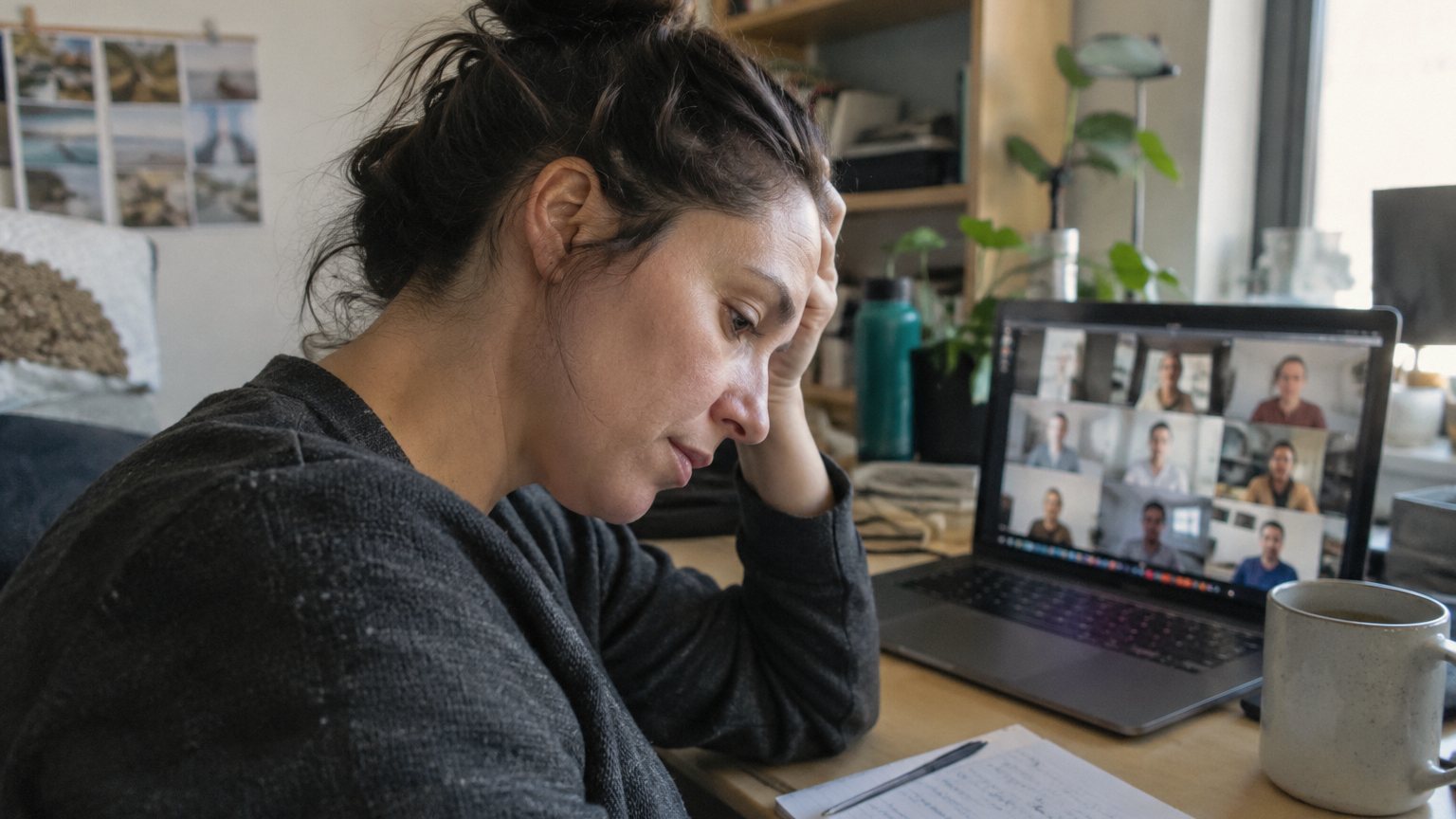
Why does the lab comparison matter?
The 2023 Scientific Reports design matters because it compared the same broad lecture situation in 2 formats: face-to-face and videoconferencing. That makes the 50-minute result more specific than a general complaint about being tired at work.
The authors used neurophysiological data and questionnaire data. They did not frame the result as a diagnosis or as proof that every person will feel the same at minute 50. They reported that the video condition, compared with the face-to-face condition, produced changes in the human nervous system that existing literature interprets as fatigue.
A 30-to-40-minute warning came from Microsoft
Microsoft WorkLab described a separate Human Factors Lab project conducted from March 8 to 18, 2021. The project involved 14 people participating in video meetings while wearing electroencephalogram, or EEG, equipment to monitor electrical activity in their brains.
That article placed sustained-concentration fatigue at around 30 to 40 minutes into a meeting. Put next to the Scientific Reports 50-minute comparison, the two public sources point to a practical window: long before an afternoon of calls is over, attention can already be under strain.
A review can turn hard before the big ask
Take a 50-minute performance review. If the first 30 to 40 minutes are status updates, the hardest speaking may arrive exactly when Microsoft’s lab described sustained-concentration fatigue and close to when Scientific Reports found video-related nervous-system fatigue changes.
That is the moment many workers blame on confidence: the voice gets flatter, the answer gets shorter, or the pay question feels harder to say. The sources do not measure pay talks or reviews directly. They do give a time benchmark for why a late-call speaking task can feel different from the same words earlier.
The two fatigue clocks side by side
The public record gives 2 useful clocks, with different samples and methods. One is a 35-person 2023 comparison of video and face-to-face lecture formats. The other is a 14-person 2021 Microsoft EEG project on video meetings.
| Source | Year or dates | People | Video-call benchmark | What was measured |
|---|---|---|---|---|
| Scientific Reports | 2023 | 35 | 50 minutes | Neurophysiological data and questionnaire data in a university lecture, comparing videoconferencing with face-to-face |
| Microsoft WorkLab | March 8 to 18, 2021 | 14 | 30 to 40 minutes | EEG activity during video meetings, described as sustained-concentration fatigue |
Public benchmarks for fatigue in videoconferencing research
What this means for you
If you control the agenda, put the most exposed speaking earlier than the 30-to-40-minute window: the raise request, the client objection, the decision slide, or the question you are nervous to ask. Save simpler updates for later.
If the meeting must run close to 50 minutes, treat the late stretch as a different speaking condition. Use shorter sentences. Pause before answering. Ask for the question to be repeated if your focus drops. The point is not to fear long video calls. It is to stop assuming every late-call stumble is a confidence failure.
Sources