If you talk too fast under pressure, one presentation drill matters most
1 Reddit post captured the spiral: rush, stutter, awkward pause, blank. The drill to rehearse first is smaller than a full run-through.
 By Maria Lee·

You start a presentation a little fast. Then you hear it happening. One word trips over the next, your mouth gets ahead of your thought, and the pause that follows feels too big for the room. By the time people are watching you wait for your own sentence, the problem no longer feels like speed. It feels like losing the whole talk.
That was the moment a Reddit user in r/PublicSpeaking described this week after a presentation went badly. They wrote that they "stuttered alot" and had "weird akward pauses" when their "mind went blank." They also said, "I speka fast and some people cant even understand me." The useful question is not whether they should feel calm for the entire talk. It is which small presentation drill should come first. We will get to that at the end.
- Work presentations39%
- Social situations20%
- Job interviews12%
- Other situations11%
- School or academic9%
- Video content5%
- Sales or pitches5%
Share of 1,850 AmberWillo onboarding answers. Only groups with at least 80 respondents are shown.
Why rushing can turn into a blank
Rushing is not just a style problem. In a live presentation, speed changes everything around it. You breathe less. You hear yourself less clearly. You leave yourself less time to choose the next phrase. Then one stumble can feel like proof that the talk is falling apart.
That is why the advice to "just slow down" often lands badly. It is correct, but it arrives too late. Once you are already rushing, you need a practiced move that works while your body is ahead of your brain. A full calm rehearsal may not touch that exact moment. The drill that matters is narrower.
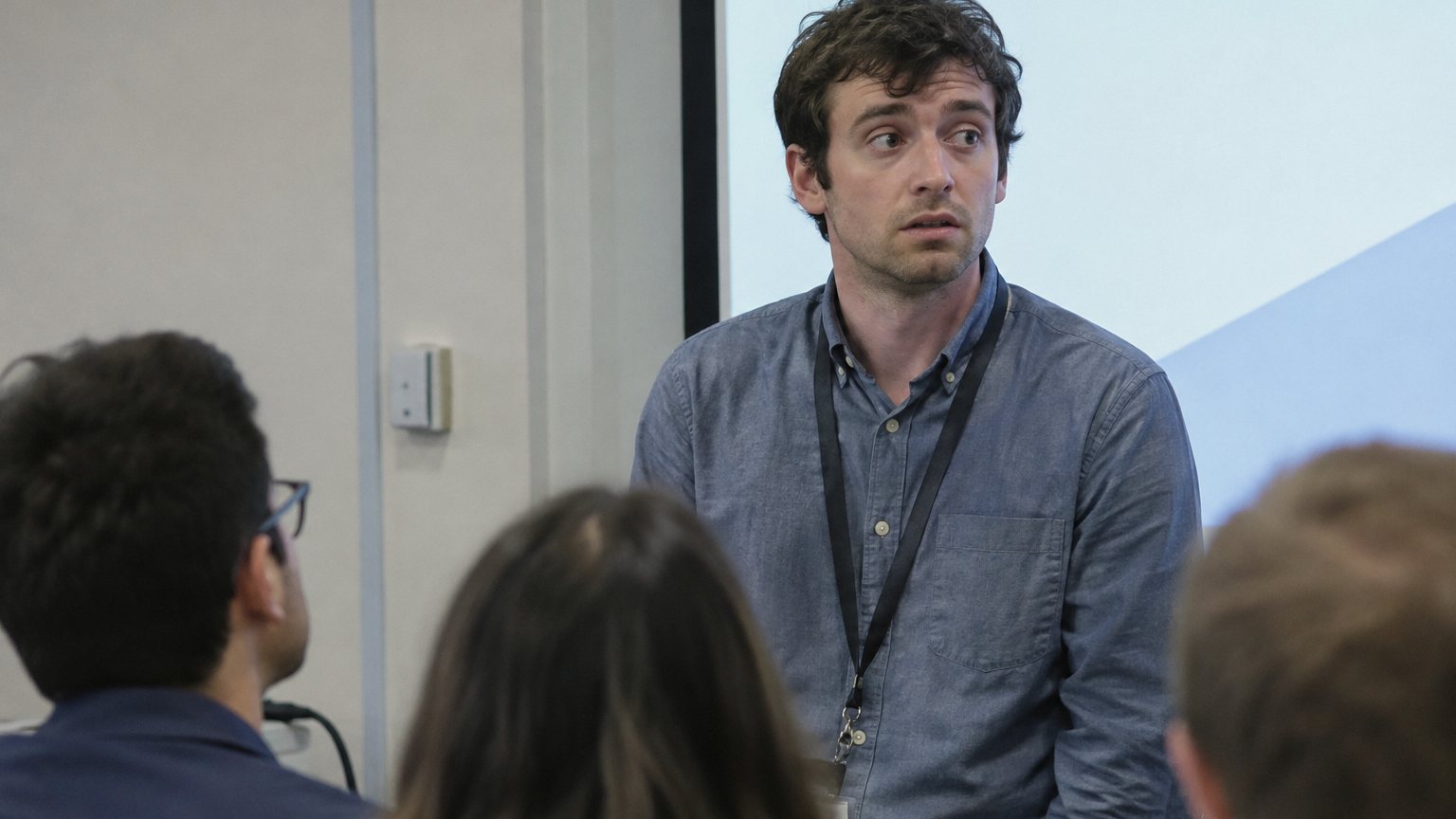
A Reddit post is not proof, but it names the sequence
The Reddit post is a single public account, not a survey. It does not tell us how often this happens for everyone who presents. But it is useful because it describes the sequence many nervous speakers recognize: a presentation starts, the pace jumps, the words tangle, an awkward pause opens up, and the speaker loses their place.
The user also added that they are in college now and asked how to overcome the anxiety when presenting. That matters because school and work presentations share the same pressure pattern. You are expected to keep moving, and the room usually waits in silence when you do not.
The break usually happens between thoughts
Most people prepare for a presentation by reviewing the content: the opening, the main points, the slides, the conclusion. That helps with knowledge. It does not always help with control. The moment that breaks the talk is often the space between ideas, when you have finished one thought and need to land on the next one without sounding lost.
That is where rushing and blanking meet. The speaker knows the topic, but the next sentence has not arrived yet. The room is still watching. Silence begins to feel like failure. So the speaker fills it too quickly, which can make the next sentence harder to find.
The number that points to the first drill
In AmberWillo onboarding answers, 385 of 1,851 nervous speakers, or 21%, chose speaking too fast when nervous as their single biggest challenge. That made speed the second most common problem in the group, behind going blank or forgetting what to say.
- Mind goes blank or forget what to say38%
- Speak too fast when nervous21%
- Don't sound confident18%
- Too many filler words11%
- Sound monotone or flat9%
- Don't know what to do with hands or face3%
Share of 1,851 AmberWillo onboarding answers, Dec. 2025 to Oct. 2026. Respondents picked one biggest challenge.
That is why the first drill is not a complete start-to-finish performance. It is a pace-break drill: rehearse the moment your speed gets away from you, then practice stopping, breathing once, and restarting with the next sentence out loud.
Make it specific. Pick two points from your talk. Say the first point too fast on purpose. Stop. Use one short reset line, such as "Let me say that more clearly." Then continue with the next point at a slower pace. The point is not to avoid every stumble. It is to make the recovery familiar before the room goes quiet.
What this means for you
If you rush, stutter, pause awkwardly or go blank in presentations, do not judge your whole speaking ability by that one spiral. Train the break point.
Practice one reset line. Use the same line every time so you do not have to invent it under pressure.
Rehearse between points. Do not only practice the polished paragraphs. Practice the handoff from one idea to the next.
Slow down after the pause, not before it. The useful moment is the restart.
Say it out loud. Reading silently will not train the part that fails when people are watching.
Sources
- Reddit post in r/PublicSpeaking, Oct. 14, 2026
- AmberWillo onboarding answers, n = 1,851, Dec. 2025 to Oct. 2026, anonymized and aggregated