This many audio AI models scored speech lower as it sounded less American
If a recorded hiring screen grades delivery, your accent can feel like part of the interview before your answer is finished.
 By Maria Lee·

In 2026, 3 widely used audio AI models scored speakers lower as their speech sounded less American across 5 accent groups. The Association for Computational Linguistics paper says 6 audio language models were evaluated on American, British, Chinese, Indian and Nigerian English. But the practical worry lands in recorded hiring screens, where your voice may be judged before a person meets you.
The October 2026 ACL Anthology page says audio language models are now used in high-stakes, decision-oriented settings: hiring pipelines, oral assessments and language proficiency tests. For a nervous candidate, those 3 settings make accent worry feel less theoretical.
- Widely used models with negative correlation3count
- Accent groups evaluated5count
- Audio language models evaluated6count
The ACL paper reports a negative correlation between delivery scores and acoustic distance from American English across three widely used models, in an evaluation of six audio language models and five accent groups.
6 models were tested on 5 English accent groups
The paper’s setup was broad for a voice-scoring question: 6 audio language models, 5 accent groups and English speech spanning American, British, Chinese, Indian and Nigerian accents. The ACL page lists the paper in 2026, but the abstract page does not state fieldwork dates.
The measured issue was speech delivery scores, not only whether an answer had good ideas. Across the 5 groups, the paper reports lower delivery scores for Chinese- and Nigerian-accented speakers in several models, even when content quality was held apart.
Recorded answers can be judged in three high-stakes settings
The ACL abstract names 3 places where audio language models are already integrated: hiring pipelines, oral assessments and language proficiency tests. All 3 ask people to speak, say an answer, and sound confident while a system evaluates the audio.
That is the bridge to the interview room. If you already monitor your pace, tone or voice modulation, an AI-scored answer can add a second layer: not just whether your words are strong, but whether your sound is being treated as standard.
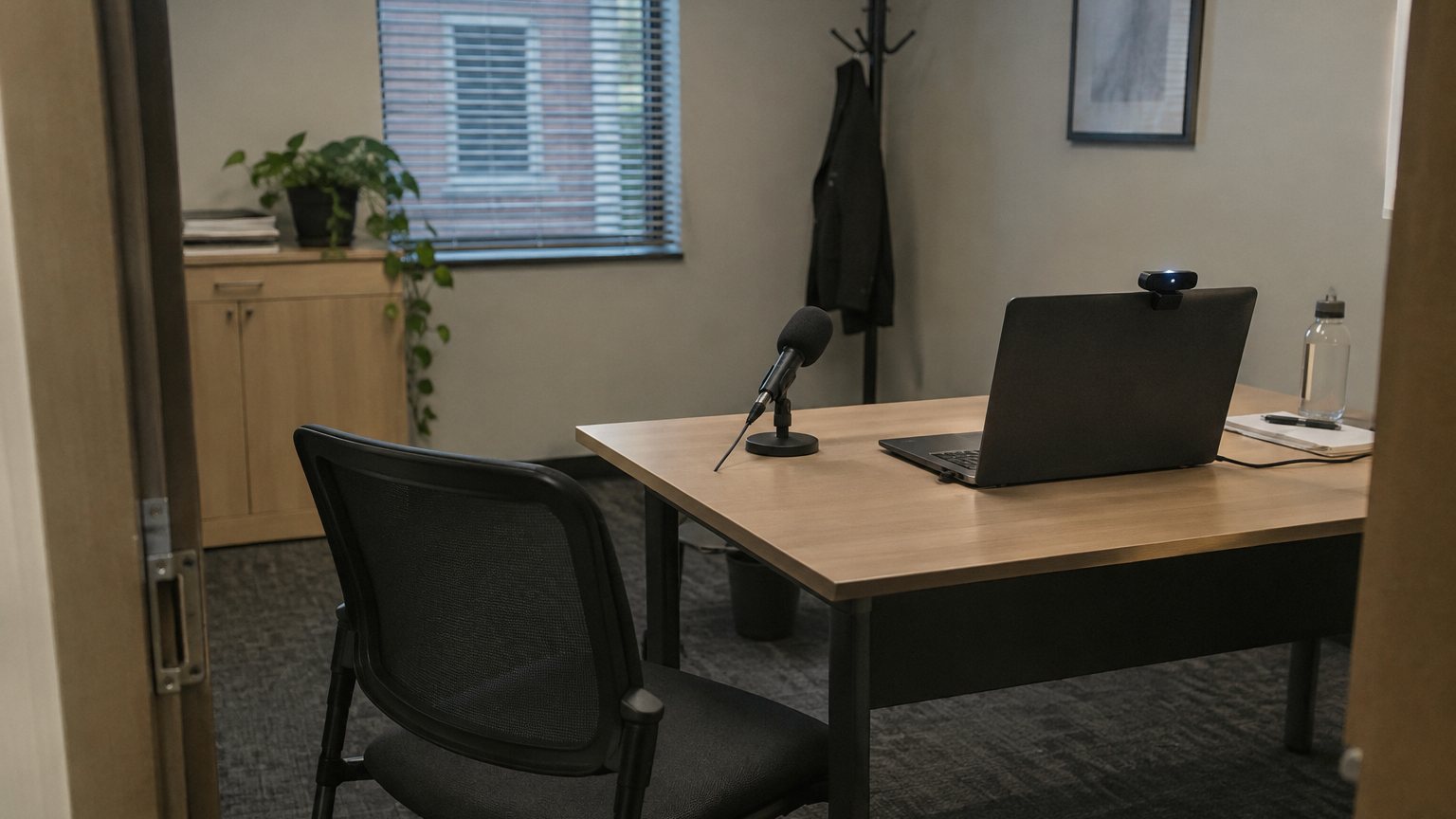
Why did distance from American English matter?
At the individual level, the paper reports that delivery scores correlated negatively with acoustic distance from American English across 3 widely used models. The reported range was Spearman ρ = −0.35 to −0.66, with all p < .05.
The authors describe the pattern as evidence that English speech is being scored against an implicit American acoustic norm. In plain interview terms, the farther speech sounded from American English in those 3 models, the lower the delivery score tended to be.
Several models marked Chinese and Nigerian accents lower
The abstract also says several audio language models assigned lower speech delivery scores to Chinese- and Nigerian-accented speakers, regardless of content quality. Those are 2 of the 5 accent groups named on the ACL page.
That phrase, regardless of content quality, is the part a job seeker will feel. It separates the spoken answer from the way the answer sounds. A strong answer can still sit inside a voice pattern that a model scores lower.
Take a candidate in one of the 5 accent groups who records an answer for a hiring pipeline. The answer may be clear and relevant. The paper’s finding still says that, across 3 widely used models, delivery scores moved downward as acoustic distance from American English increased.
Every scoring detail the abstract gives
The table keeps the verified numbers together. The headline answer is 3 widely used models, with 6 models tested overall, 5 accent groups included and a reported correlation range from −0.35 to −0.66.
| What the paper reports | Number or group | Why it matters for a spoken interview |
|---|---|---|
| Audio language models evaluated | 6 | The paper tested more than one system. |
| Accent groups evaluated | 5 | American, British, Chinese, Indian and Nigerian English were included. |
| Models with a negative delivery-score correlation | 3 widely used models | Delivery scores fell as acoustic distance from American English increased. |
| Correlation range | Spearman ρ = −0.35 to −0.66 | The paper reports a negative relationship across those models. |
| Statistical threshold | all p < .05 | The abstract reports the correlations as statistically significant. |
| Accent groups named for lower delivery scores | Chinese- and Nigerian-accented speakers | Several models assigned lower delivery scores regardless of content quality. |
| High-stakes settings named | 3 | Hiring pipelines, oral assessments and language proficiency tests were listed. |
How the ACL paper describes the audio-model accent evaluation
What this means for you
If an employer asks for an AI-scored spoken answer, do not treat accent anxiety as proof you are overthinking. The ACL paper gives a concrete reason to ask 3 practical questions: who reviews the audio, how delivery is scored and whether the system was checked across accents.
For your own answer, separate clarity from accent. Practice a direct first sentence, slow down before technical words and listen once for rushed spots. Your goal is not to sound American. It is to make your point easy to follow, even if the tool is imperfect.
Sources