Public Speaking Practice Exercises: A Complete Guide to Improve Your Skills
Updated August 20, 2026
Start here
You do not need more speaking advice. You need to know which advice applies to you.
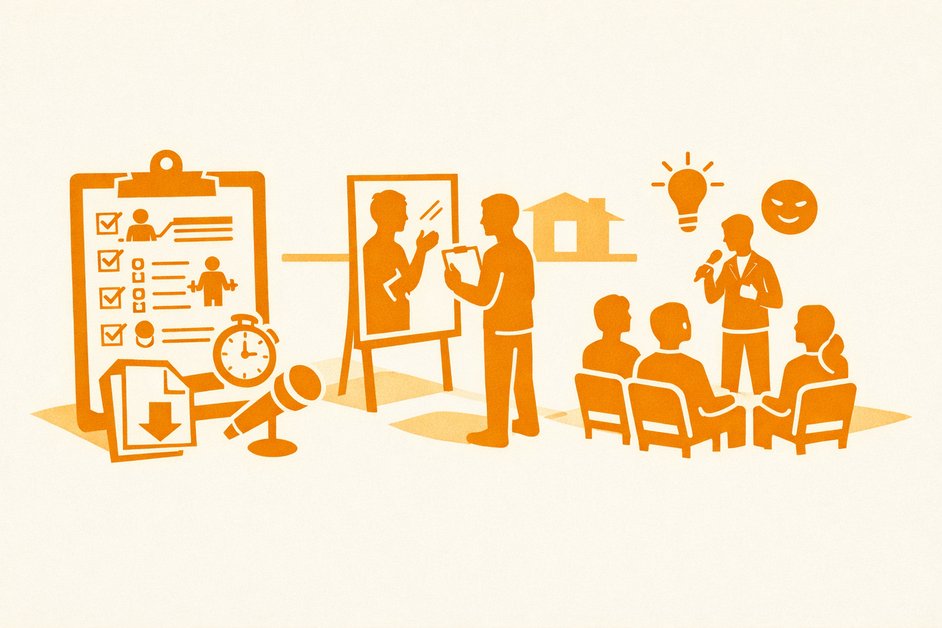
A 30-second rep shows how you actually come across when you speak. That is the difference between collecting advice and using it. The rep is simple: you get two random words and 30 seconds to talk out loud, working both into what you say. Our AI reads your voice and your face, gives you a score out of 10, and turns what it found into a custom plan: what to fix first and what to practice.
Free. You see your score right after you speak. Only you see it.
Public speaking practice exercises are structured activities designed to enhance your communication skills and reduce anxiety. These exercises include techniques like impromptu speaking, role-playing, and mock presentations. You can practice in front of a mirror or record your presentations. This complete guide will show you how to improve your public speaking ability and build confidence.
Public speaking practice improves with tips and tricks for effective skills. Daily public speaking exercises aim to improve your skills. Regular speech practice reduces anxiety and increases confidence. Improving public speaking skills requires regular practice, thorough preparation, and engaging your audience. Public speakers improve through practice actions with a positive attitude. Public speaking exercises are effective ways to polish skills and overcome fears. Regular practice of public speaking exercises builds confidence and instills self-assurance. Public speaking practice is key to improving your ability.
What Are Public Speaking Practice Exercises?
Public speaking practice exercises are structured activities designed to improve your communication skills and confidence. They include methods like impromptu speaking, role-playing, and mock presentations. These exercises often target specific aspects of public speaking or communication, such as breath control, diction, or body language.
You can improve your public speaking skills through self-practice. These techniques can involve looking in a mirror, recording yourself, or rehearsing in an empty room. Practice sessions can happen in front of a mirror or with friends watching. Practicing with friends or family is a common method for public speaking practice. Many exercises focus on specific training aspects, such as voice modulation, body language, eye contact, and speech organization. Daily practice helps improve your public speaking skills, including talking pace, confidence, and presentation styles. Daily exercises aim to improve public speaking skills by encouraging regular, consistent practice rather than last-minute cramming. For beginners, joining a speaking club or Toastmasters is among the best public speaking exercises. Virtual group classes, like Simply Public Speaking, offer opportunities to practice in front of a group, with exercises tailored to your interests. Effective public speaking and confidence courses should include real-time practice in front of others.
Why Practice Exercises Are Essential for Overcoming Public Speaking Anxiety
Practice in public speaking is essential for overcoming fear of public speaking, helping to reduce uneasiness and anxiety. Consistent practice and thorough preparation build authentic confidence and reduce anxiety. This approach is key to developing effective public speaking skills, building confidence, overcoming anxiety, and delivering impactful presentations.
You can overcome public speaking anxiety by practicing until you feel confident. Developing your speaking voice and regularly practicing public speaking exercises are crucial steps to overcome fear and become an effective speaker. Daily public speaking exercises are necessary to address fear and anxiety, especially in impromptu speaking situations. According to mayoclinic.org, fear of public speaking can be overcome through preparation, practice, and seeking help. Regular practice of public speaking exercises builds your confidence level and instills self-assurance. For example, students struggling with public speaking anxiety can overcome it by practicing their speech multiple times. Grabbing every chance to speak in public also helps build familiarity.
How to Choose the Right Public Speaking Exercises for Your Needs
To choose the right public speaking exercises, consider your current skill level and specific goals. For beginners, recording and analyzing your speeches is a top exercise. This helps you identify areas for improvement.
Joining a speaking club or Toastmasters also helps beginners build confidence and receive feedback. Practicing breathing techniques is another effective exercise for beginners to manage anxiety. Daily public speaking exercises can involve practice topics like persuasive speech ideas, which helps you develop content and delivery.
Step-by-Step Public Speaking Exercises for Beginners
Public speaking exercises for beginners offer a structured way to improve your skills and manage anxiety. Regular practice is key for beginners, and you can start small by practicing with familiar groups. These exercises include techniques like impromptu speaking, role-playing, and mock presentations, covering aspects like voice modulation, body language, eye contact, and speech organization. Practice should happen in manageable chunks, and beginners should practice speech by rehearsal to build confidence and overcome imposter syndrome. Building confidence through these exercises helps you deliver speeches with poise and conviction, and according to Mayo Clinic, beginners should challenge specific worries about public speaking. You will find detailed steps for techniques such as breathing and posture, voice control, impromptu speaking, and using gestures in the sections that follow.
Breathing and Posture Techniques
Breathing exercises for public speaking practice begin with adopting a grounded posture. Optimal body placement for breathing involves an elongated spine, unlocked knees, and a naturally expanded chest. A balanced breathing technique requires a position with an upright spine and loose neck, making it easier to breathe when holding a straight posture than when hunched. Maintaining proper posture enhances your breathing, and loosening restrictive clothing is also part of good breathing posture advice. For specific techniques, after mastering Belly-Breathing while lying down, you can progress to sitting or standing postures. For Box Breathing, maintain a mindful upright posture with your feet flat on the floor, or you can perform the Box Breathing technique either seated or lying down, with lying down on your back with bent knees being preferred. The 3-4-5 Breathing technique can also be performed while sitting on a chair.
Voice Control and Enunciation Drills
Voice control and enunciation drills help you speak clearly and effectively. You can use interactive language-learning tools like Pronounce to practice intonation drills. For example, GetPronounce AI Powered Speech Feedback provides instant feedback and multiple drills to master speaking. These public speaking practice exercises give you precise guidance to improve your delivery.
Impromptu Speaking and Storytelling
Impromptu speaking and storytelling are essential public speaking practice exercises that help you develop quick thinking and eloquent speaking. A storytelling strategy helps you give engaging impromptu speaking answers. When speaking without preparation, start your impromptu speech with a story related to the topic. During an impromptu speech, use storytelling techniques that feature truth, relevance, and impact, and steer your story to emphasize your belief and a universal lesson. You should focus on talking about personal experiences, and forming story banks in your mind helps you prepare. When called to speak without preparation, incorporate anecdotes or examples; weaving in stories is a key part of your speech content. An impromptu speech quick guide focuses on maintaining body language and storytelling tactics. If you run out of things to say, pivot by giving another example or story.
Using Gestures and Body Language Effectively
Your public speaking performance improves with six skills-building exercises for effective body language. Practice helps you use body language instinctively, leading to more dynamic presentations. Effective body language in presentations requires you to practice using gestures effectively. For instance, placing your hands by your sides and using deliberate hand gestures is a recommended technique. Think about the physical expression of your message to avoid mechanical gestures; hand gestures should be controlled and balanced, avoiding extremes of being too wild or too still. The effectiveness of your body language increases when you use gestures and postures in your own natural and ethically appropriate way. You should also use open gestures, such as uncrossed arms and a relaxed posture. Use hand gestures to emphasize key points, as strong gestures amplify your message's meaning. Effective hand gestures captivate your audience and deliver your message with clarity.
Public Speaking Exercises for Solo Practice at Home
Public speaking exercises for solo practice at home help you build confidence and refine your delivery in a private setting. You can improve your skills by speaking in front of a mirror or recording yourself. This allows you to experiment with different tones and delivery styles without an audience. Activities like talking without stopping for a fixed time also enhance your practice. For more detailed guidance, consider specific techniques like mirror practice and self-recording, or tongue twisters and vocal warm-ups.
Mirror Practice and Self-Recording
Mirror practice is a technique used to enhance public speaking skills. It involves standing in front of a full-length mirror while delivering a speech or presentation. This helps you assess your body language, facial expressions, and tone. Mirror talk exercises build self-awareness of your pace, voice modulation, expression, and body language. Viewing and self-judging your nonverbal communication and speech features improves public speaking skills.
Tongue Twisters and Vocal Warm-Ups
Tongue twisters and vocal warm-ups are effective public speaking practice exercises that enhance your delivery. A tongue twister warm-up practices precise diction, sounding louder, emotional tone, eye contact, and volume and speed variation. You can include variations by saying tongue twisters with different emotions, using gestures and eye contact, and varying volume and speed. This activity involves running through tongue twisters of different lengths to practice consonants and breath control. Tongue twisters serve as a public speaking warm-up exercise to improve articulate speech and clear pronunciation. Using tongue twisters as a vocal warm-up improves articulation and pronunciation clarity. Regularly using tongue twisters is recommended as a vocal warm-up before extended speaking. They improve pronunciation accuracy by articulating complex sound combinations and exercising speech muscles. Tongue twisters are used for training dedicated speakers, focusing on voice, articulation, and concentration. These exercises emphasize fun and challenging speech skill practice through rapid repetition and sound play. They also serve as tools to challenge your speech muscles, refining pronunciation. As vocal exercises for public speaking, tongue twisters help improve word enunciation speed and accuracy. Combined with vocal range exercises, they improve articulation and dynamic, expressive tone development.
Group Public Speaking Exercises to Build Confidence
Group public speaking exercises help you build confidence by providing real-time practice in front of others. You can gain confidence through regular practice in a supportive, relaxed environment. For introverted persons, start with smaller audiences and low-stakes public speaking situations. This includes practicing in front of a group of close friends or relatives. Learning to speak in front of a group is a key way to gain confidence.
Improvisation Games and Storytelling Circles
Improvisation games and storytelling circles are dynamic public speaking practice exercises that build essential communication skills. Improvisation games encourage you to develop quick thinking, effective communication, and confident delivery. Storytelling games and improvisation exercises enhance creativity and speaking skills. Improv games, such as 'Yes, and' or 'One-Word Story', help develop spontaneity, creativity, and confidence in a fun environment. A storytelling circle exercise promotes your listening and quick thinking skills through seamless narrative adaptation; this activity also promotes turn-taking and creativity. Organized improvisation games like 'Yes, And...' or 'Build a Story' require you to think on your feet. Storytelling games enhance creativity, communication skills, and your connection to stories. The 'One word at a time Story' improv game teaches collaborative story building, encouraging improvisational skills by requiring you to listen, accept contributions, and avoid planning ahead. Improv and acting games for children often include storytelling circles and word-at-a-time stories. Storytelling improv games may be performed by any number of people, making them versatile for various practice settings.
Peer Feedback and Role-Playing Scenarios
Role-playing and simulation exercises offer constructive feedback for improving your delivery and building confidence. These scenarios provide immediate feedback from observers or participants, including guidance during your practice sessions. Role-play scenarios involve creating situations, pairing with others, and taking turns playing roles, using appropriate tones. For example, one scenario, 'Giving and Receiving Feedback,' has a feedback giver provide constructive feedback while the receiver listens and responds. A role-playing exercise with respectful communication scenarios involves the class giving constructive feedback and suggestions after each role-play. Another no-prep activity, 'Role-Play Scenarios,' includes a Listener providing feedback on communication approaches, focusing on how each approach made them feel. Role-playing scenarios also provide participant feedback on your adaptability and offer an opportunity for immediate feedback and reflection. Students share peer feedback, including praise and constructive suggestions, after reflecting on their role-play, and they provide constructive feedback after role-play sessions. These sessions help students practice offering and accepting constructive criticism.
Tips to Maximize the Effectiveness of Your Practice Sessions
To maximize the effectiveness of your public speaking practice sessions, set specific and clear objectives. Focus your public speaking practice session goals on improving specific aspects of delivery. You should concentrate on the three most important areas for improvement, practicing one solution at a time repeatedly. Perfect key moments like the opening, transitions, and punchlines, and practice the speech in segments rather than sequentially.
Structure your practice by defining both the general and specific purpose of the speech, along with its main points. Organize your material effectively to attain the speech's purpose, ensuring the audience's attention is grabbed in the first 30 seconds. For a unique approach, practice delivery while engaged in a light cardio activity that brings your heart rate into a Zone 2 range.
Printable and Downloadable Public Speaking Exercise Lists
Public Speaking Worksheets for Kids are available as free printable PDFs. Parents can download and print these worksheets to help their children. These printable activities encourage children to practice speech preparation, storytelling, and expressing ideas clearly while speaking. Many worksheets include storytelling prompts, speech preparation activities, and conversation practice. Worksheets are designed to build different communication and language skills.
For a broader resource, The 4-H Public Speaking Project guide provides a list of six learning experiences. This guide also includes a lesson on Dealing with Fear and Anxiety, and it offers a lesson on Developing Your Own Style. You can also find a lesson on Getting to Know Your Audience. The guide features an activity called Throw That Fear Away, and another activity is Focus on the Auditory. Daily public speaking exercises can include practice scripts and PDFs.
How Regular Practice with AmberWillo Can Help You Overcome Stage Fright
Specific details on how AmberWillo directly helps overcome stage fright are not available in the provided information. However, regular practice is key to building confidence and reducing stage fright. Facing stage fright and practicing regularly enables individuals to gradually build confidence and overcome stage fright.
Stage Fright Coaching helps overcome stage fright through practical exercises and mental training. Coaching sessions offer practice opportunities in a safe environment with constructive feedback. This approach utilizes proven techniques and provides practical recommendations. These preparation strategies can help you overcome stage fright.
Related Topics: Public Speaking Practice Activities and Exercises
Public speaking practice involves various techniques and activities designed to enhance your communication skills. These methods include speaking in front of a mirror, recording yourself, or presenting to family, friends, or colleagues. Self-practice activities also involve rehearsing in an empty room.
You can conduct practice sessions in front of a mirror or with friends watching. Practicing with friends or family is another effective method. For beginners, recording and analyzing speeches are among the best exercises. Practicing breathing techniques is also a top exercise for beginners, as is joining a speaking club or Toastmasters. Public speaking exercises include techniques like impromptu speaking, role-playing, and mock presentations for speaking scenarios preparation. Effective practice involves speaking out loud, in small random sections, and conversationally. A Public Speaking Practice Game can transform your practice, making daily conversations a fun and simple game for 30 seconds. Making public speaking practice a game is a recommended tip for improving skills.
Frequently Asked Questions About Public Speaking Practice Exercises
The 2024 Summer Olympics, officially known as the Games of the XXXIII Olympiad, will be held in Paris, France, from July 26 to August 11, 2024. This marks the third time Paris has hosted the Olympic Games, having previously done so in 1900 and 1924. The opening ceremony will take place on the River Seine, a first in Olympic history, and the event will feature 32 sports across 48 disciplines. A total of 10,500 athletes are expected to participate.
How often should I practice public speaking exercises?
You should practice your speech many times, ideally dozens of times, to build confidence. Practice new public speaking exercises four or more times weekly for effective skill learning. Commit to daily practice, even if it's only 30 seconds, especially when learning new public speaking skills. When you are working on changing specific speech habits, practice them once or twice per day, for about one minute each time. Repeat each public speaking exercise at least four times to reinforce learning.
Can these exercises help with social anxiety and stage fright?
Yes, these exercises can significantly help with social anxiety and stage fright. Physical activity interventions are a promising way to treat social anxiety disorder, according to pmc.ncbi.nlm.nih.gov. Exercise can quiet social anxiety and helps calm your nervous system. Regular physical activity is a great tool for reducing social anxiety, and regular exercisers experience lower levels of it. Starting an exercise program can reduce social anxiety symptoms more than not exercising, and combining therapy with a weekly 90-minute walking workout can improve symptoms better than therapy and education alone. Additionally, exercise can help you if you feel overly nervous about a big presentation. Deep breathing, relaxation exercises, yoga, and meditation also calm the mind and body to reduce stage fright, as noted by adaa.org, which also states that healthful lifestyle habits, including exercise and eating well, can reduce stage fright.
What are the best exercises for improving speech clarity?
To improve speech clarity, focus on specific public speaking practice exercises. Articulation exercises, often used in speech therapy, aim to improve speech clarity. Speaking exercises for clarity include enunciation practice, where you focus on speaking slowly and clearly enunciating. Focusing on proper pronunciation is also key. Vocal warm-up exercises can also improve speaking clarity, and breathing exercises for public speaking also improve the clarity and articulation of words. The best public speaking vocal exercises improve both vocal clarity and confidence. Overall, public speaking exercises help improve the clarity and articulation of speech, and if needed, seeking feedback or speech therapy can further improve speaking clarity.
How do I track my progress in public speaking skills?
To track your progress in public speaking skills, regularly record and review your speeches. You should record your talk and analyze it afterward to identify strengths and areas for improvement. Practicing regularly includes recording yourself and analyzing performance. Effective practice for public speaking improvement includes video recording yourself. You can track your progress by noting improvements in speaking skills and confidence levels. Measuring success also involves evaluations in public speaking workshops and presentations to peers or management. These DIY public speaking improvement techniques help you see how far you have come.
Keep reading


